Showing posts with label interactive timeline. Show all posts

Friday, December 21, 2012

Rogers’ Chocolates since 1885

 
Rogers' Chocolates celebrated its 125th Anniversary on October 25th, 2010. The company is steeped in tradition and a rich history that has earned them a reputation as one of Canada's premiere chocolate makers. The first Rogers' chocolates were made in 1885 by Charles "Candy" Rogers in the back of his grocery store in Victoria, British Columbia. He quickly became a popular man.

In 1891, Rogers expanded his chocolate operation to the company's current heritage storefront on Government Street in Victoria and the rest, as they say, is history. Today, there are 8 retail stores, several hundred wholesale outlets that ship to over 50 countries, and a 20,000 square-foot factory.  For more information, visit the History webpage. Also, see the timeline on A Brief History of Chocolate from 250BC to 2010, and view the Rogers Videos on YouTube.


Monday, March 12, 2012

SEC Historical Society – 10th anniversary and timeline update


The Securities and Exchange Commission (SEC) Historical Society, through its virtual museum and archive, shares, preserves and advances knowledge of the history of financial regulation. It is a non-profit organization, independent of the US Securities and Exchange Commission.

The SEC Historical Society celebrates the 10th anniversary of its founding in 2012. Since opening on June 1, 2002, this independent and objective resource provides access to primary materials on the creation and development of the regulation of the capital markets from the 20th century to the present.


The comprehensive collection includes a Virtual Museum Timeline that highlights significant developments in the history of financial regulation against US and world events. To start, choose a decade, click the arrow button to move through the years, and click on any development to read more. In addition, learn more about building the Timeline.

The collection also includes: Galleries (permanent exhibits within the museum, providing access to materials from throughout the collection on a particular topic); Papers (letters, speeches, memos, telegrams and reports, many not accessible through other online sources); Photos (historic and current images of people significant to financial regulation); and Oral Histories (remembrances, available in audio, MP3 and edited transcript formats, from people who helped create and continue to shape the financial regulatory system). As well, the collection comprises a variety of original programs - including Fireside Chats, the Society's Annual Meeting, The Best of NERA, etc. - offering historic perspective on current regulatory issues (broadcast live and preserved in audio, MP3 and edited transcript formats).

Tuesday, September 13, 2011

A History of Ernst & Young


The roots of Ernst & Young go back to the 19th century and its founders Arthur Young and Alwin C. Ernst. Arthur Young was born in Glasgow, Scotland. He graduated in law, but became interested in banking and investment. In 1890, he moved to the US to pursue his career in accounting. In 1906, he formed an accounting firm, Arthur Young & Company, with his brother Stanley. Alwin C. Ernst was born in Cleveland, Ohio. After leaving school he worked as a bookkeeper. Then, in 1903, he and his brother Theodore started Ernst & Ernst, a small public accounting firm.

Young and Ernst were innovators and appreciated the importance of quality in their work. Ernst pioneered the idea that accounting information could be used to make business decisions. Young positioned himself as a business advisor. Both firms were also quick to enter the global marketplace. As early as 1924, they allied with prominent British firms: Young with Broads Paterson & Co. and Ernst with Whinney Smith & Whinney. These alliances were the first of many for both firms, which opened offices around the world to service their international clients.

Ernst and Young never met in life, but died within days of each other in 1948. Their philosophies lived on and, in 1989, were brought together when the firms they started combined to create Ernst & Young. The new organization quickly positioned itself on the leading edge of rapid globalization, new business technologies and continuous business change.


View the brief history and a timeline at the Ernst & Young Canada website.

Tuesday, June 7, 2011

CAmagazine - 100-year overview

When The Canadian Chartered Accountant began publishing 100 years ago, editors said its pages would be “open for discussions, for news and for any other purposes tending to bring the members more closely in touch with one another.” Sensibly, they made no claim for how the magazine would strengthen the community and instead focused on reporting and offering insight on events and issues critical to CAs. For a century, the magazine has acted as the profession’s adviser, referee, historian and, occasionally, conscience. The article “100-year overview” in the June-July 2011 issue of CAmagazine celebrates those who built, sustained and helped CAmagazine prosper. Happy birthday!

Wednesday, April 13, 2011

Shell Canada - Celebrating 100 Years

In 2011, Shell Canada celebrates 100 years of business. To celebrate this milestone, it is launching exciting programs from coast to coast to say thank you to Canadians. A lot has changed since 1911, but Shell has remained committed to innovation and leadership. It strives to leave a positive legacy for all Canadians for generations to come. Read the Anniversary Press Release and Explore 100 Years of Innovation through an Interactive Timeline.

Tuesday, March 1, 2011

ICAEW - Timeline of the Accountancy Profession in the United Kingdom

The comprehensive ICAEW Timeline explores events from ancient times through to the first half of the nineteenth century (for detailed events, click on the red titles – for example, 1853 - 1880 and 1968 - 2003. The Timeline shows when accountancy starts to take form as an organized profession, growing primarily as a result of the commercial and legal activity of bankruptcy, insolvency and the winding up of companies all the way to the current day.

Monday, February 7, 2011

PricewaterhouseCoopers - A Firm History

PricewaterhouseCoopers (PwC), one of the world’s largest accountancy firms, was created in 1998 through the merger of two firms, Price Waterhouse and Coopers & Lybrand. Each firm has historical roots going back about 150 years to 19th century Great Britain (explore PwC's First 100 Years in Canada). The collection of PwC archival materials, donated to Columbia University in August 2000, traces the rise of both firms to become major worldwide professional services powerhouses through mergers and business expansion. To learn more about these extensive archives, visit the Archival Collections at the Columbia University (in the City of New York) Rare Book and Manuscript Library online. The Archival Collections provide access to descriptions and finding aids for more than 3,500 archival collections in six Columbia University Libraries repositories. These collections include personal papers, institutional records, corporate archives, architectural drawings and much more.

Wednesday, December 22, 2010

Canada's History and the Hudson's Bay Company

In 1994, the Hudson's Bay Company donated its corporate archives to what is now the Archives of Manitoba, and its museum collection to The Manitoba Museum, both public institutions. These gifts earned a substantial tax saving, most of which was put to work in the name of history by establishing the Hudson's Bay Company History Foundation. The Foundation, in turn, provides core funding to ensure the maintenance of the Company's gifts and to support the initiatives of Canada's History. Canada’s History operates independently of the Foundation and realizes additional funding through memberships, donations and sponsorships. As a registered charity, it can accept donations and issue receipts for income tax purposes.

Wednesday, November 3, 2010

Institute of Chartered Accountants of British Columbia - Centenary Website

The Institute of Chartered Accountants of British Columbia (ICABC) celebrated its 100th anniversary in 2005. It was marked with events, articles in Beyond NumbersCentenary Artwork, an online timeline of the history of CAs in BC, and a calendar. An expanded look at these contributions is provided on the ICABC centenary website which describes the people and events that have shaped the profession in BC.

Friday, July 2, 2010

Opening the Door to Financial Regulatory History

At a time when financial regulatory reform is capturing headlines, an online museum administered by the SEC Historical Society is granting users equal access to resources, relics and research material. The online galleries preserve eyewitness accounts, oral histories, correspondences, research papers and photographs. An interactive timeline features hundreds of digital artifacts. Interviews and round-table discussions cast light on current topics. (Read the article "Opening the Door to Financial Regulatory History" in the June 2010 Journal of Accountancy online.)

Monday, April 5, 2010

Deloitte in Canada - 150 years and counting...

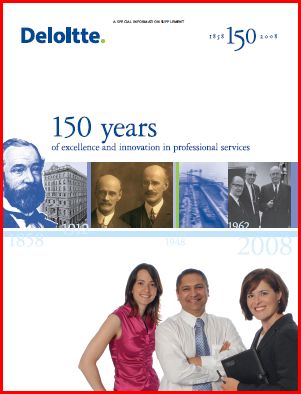
The history of Deloitte not only records the development of accounting in Canada, it is also a study in the evolution of professional services – from the days when bookkeepers in “public practice” focused mainly on estates, trusts and liquidations, to the diverse service offerings of today in which auditors, tax specialists, management consultants and financial advisors routinely assist organizations in addressing a wide range of financial, operational, regulatory and other matters. (Read highlights of The history of Deloitte in Canada and the booklet Deloitte 150 years of excellence and innovation in professional services. Also, view an interactive timeline that tracks the evolution of the firm since 1858, along with the growth of Canada and the CA profession.

Monday, March 29, 2010

SEC Historical Society virtual museum

The SEC Historical Society's virtual museum and archive is an open door to the history of the regulation of the capital market system from the 20th century to the present. Its collection is built and exhibited independent of any oversight from the U.S. Securities and Exchange Commission (SEC). Founded in 1999, the SEC Historical Society is a non-profit organization and receives no funding from the public sector. Read the Society's most recent Annual Report.


The museum and archive's comprehensive collection includes:
  • Timeline: Linking regulatory developments against U.S. and world events from 1930 to the present.
  • Galleries: A unique search function within the museum, providing an alternate way to access all museum material on a particular subject. Current Galleries look at insider trading, international financial regulation and eras in SEC history.
  • Papers: Letters, speeches, memos, telegrams and reports, many not accessible through other online sources.
  • Photos: Historic and current images of people significant to financial regulation.
  • Oral Histories: Remembrances, available in audio, MP3 and edited transcript formats, from people who helped create and continue to shape the financial regulatory system.
  • Programs: A variety of original programs - including Fireside Chats, the Society's Annual Meeting, The Best of NERA, etc. - offering historic perspective on current regulatory issues. Broadcast live on www.sechistorical.org, and preserved in audio, MP3 and edited transcript formats.