Showing posts with label auditing standards. Show all posts

Tuesday, November 6, 2012

PSAAC - What It Is & What It Does


“PSAAC” stands for the Public Sector Accounting and Auditing Committee of the Canadian Institute of Chartered Accountants (CICA). PSAAC was established in 1981, to improve and harmonize public sector accounting and auditing practices. Its creation followed extensive consultation with federal and provincial governments and legislative auditors, and an in-depth CICA study of their financial reporting.
 
That study, Financial Reporting by Governments (1980), found wide disparities in government reporting practices. Government financial statements often reported fragmented and incomplete information, leaving out major operating units and liabilities. So, the financial statement information was inadequate for both decision-making and accountability. In addition, similar transactions were being reported very differently from government to government. As a result, useful comparisons of one government’s financial statements with those of another were almost impossible. The study called for accounting standards tailored to reflect the nature of government objectives and operations, and to meet information needs of the users of government financial statements and reports.
 
In 1991, a tenth anniversary pamphlet was issued on PSAAC - What It Is & What It Does. The pamphlet explains: what it is; why it was formed; how it works; what it’s done; where it’s going; and progress to date. According to the pamphlet: “PSAAC’s role is: To serve the public interest by strengthening accountability in the public sector through developing, recommending and gaining acceptance of accounting and auditing standards of good practice. The Committee issues its recommendations in Public Sector Accounting and Auditing Statements and Guidelines. It also initiates research studies to serve as input to the standard-setting process and to stimulate thought and debate on contentious or complex issues.” An Appendix to the pamphlet lists seven accounting statements, four auditing statements, two auditing guidelines and four research studies issued up to that point in time.

Wednesday, August 15, 2012

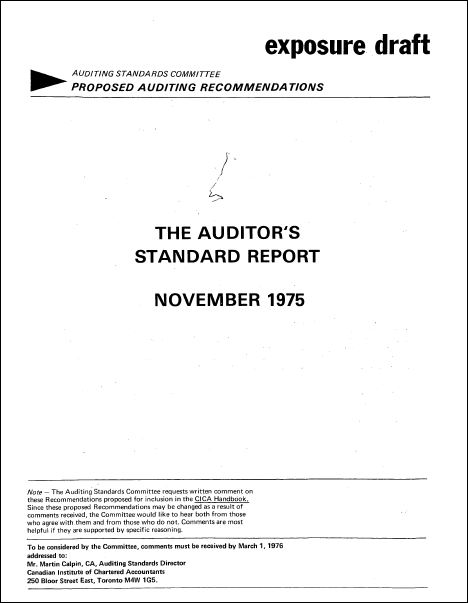
The Auditor’s Standard Report (1975)


In November 1975, the Auditing Standards Committee of the Canadian Institute of Chartered Accountants issued an exposure draft dealing with The Auditor’s Standard Report. This Exposure Draft was the first stage of a complete updating and revision of the CICA Handbook Section 5500 - The Auditors’ Report.

According to the exposure draft, “The auditor's report is a comprehensive subject and the Committee believes that it would be useful and more efficient to divide present Section 5500 into several separate sections within the Handbook under such section headings as the following: Section 5400 The Auditor’s Standard Report; Section 5500 The Auditor’s Reporting Reservations; Section 5600 Special Reports; and Section 5700 Other Reporting Matters.”

The exposure draft stated that: “The auditor’s standard report is normally presented in two paragraphs. The first ("scope") paragraph identifies the financial statements reported on and contains a reference to the scope and nature of the auditor’s examination. The second ("opinion") paragraph expresses the auditor’s opinion resulting from that examination.” The major changes proposed in the exposure draft were (a) revision of the scope paragraph to state that the auditor’s examination was made in accordance with generally accepted auditing standards; and (b) removal of the two-part opinion concept.


Friday, July 6, 2012

Generally Accepted Auditing Standards: Audit Evidence – 1977


In February 1975, the CICA’s Auditing Standards Committee (AuSC) proposed, subject to comments received following exposure, to publish the contents of an Exposure Draft as CICA Handbook: Section 5100 - Generally Accepted Auditing Standards. In July 1976, the AuSC issued a 32-page Exposure Draft on “Internal Control” (for inter-related Sections 5200 to 5230).

Then, in May 1977, the AuSC issued a 12-page Exposure Draft on “Audit Evidence” (for Sections 5300). This material was intended to provide guidance, in general terms, as to the attributes of audit evidence and the manner in which the auditor obtains and evaluates such evidence to adhere to field work standard (iii) within generally accepted auditing standards. Field work standard (iii) states: “"Sufficient appropriate audit evidence should be obtained, by such means as inspection, observation, enquiry, confirmation, computation and analysis, to afford a reasonable basis to support the content of the report.”

The Exposure Draft emphasized that “The auditor is concerned with audit evidence in all phases of his audit engagement, from the planning stage, through the study and evaluation of internal control including the performance of compliance auditing procedures, to the performance of substantive auditing procedures.” It addressed the following matters: Introduction and Definition; Knowledge of the Business; Necessity for Performing Substantive Auditing Procedures; Sufficiency and Appropriateness of Evidence; Methods of Obtaining Evidence; Timing of Auditing Procedures; Errors and Irregularities; and Evaluation of Audit Evidence. In this regard, “The auditor relies on his professional judgment [emphasis added] in deciding which procedures will give him sufficient appropriate audit evidence. He evaluates the audit evidence gathered to determine the content of his report.”

Thursday, June 21, 2012

Generally Accepted Auditing Standards: Internal Control – 1976


In February 1975, the CICA’s Auditing Standards Committee (AuSC) proposed, subject to comments received following exposure, to publish the contents of an Exposure Draft as CICA Handbook: Section 5100 - Generally Accepted Auditing Standards.

The following year, in July 1976, the AuSC issued a 32-page Exposure Draft on “Internal Control.” This material (for inter-related Sections 5200 to 5230) was intended to provide an explanation, in general terms, of what the auditor should do in order to comply with field work standard (ii) within Generally Accepted Auditing Standards (GAAS). Field work standard (ii) states: “There should be an appropriately organized study and evaluation of those internal controls on which the auditor subsequently relies in determining the nature, extent and timing of auditing procedures."


The Exposure Draft addressed the following matters: Management’s objectives; Basic components of internal control systems; Auditor's objective regarding internal control; Auditor's approach – overview; Auditor's study and evaluation; and, Relationship to substantive auditing procedures. A decision tree was provided in Appendix A on page 32 (refer to the graphic above). It is noteworthy that the Exposure Draft also mentioned that the AuSC was working on a project to provide a similar explanation with respect to field work standard (iii) - Audit Evidence.