Showing posts with label financial reporting. Show all posts

Tuesday, November 6, 2012

PSAAC - What It Is & What It Does


“PSAAC” stands for the Public Sector Accounting and Auditing Committee of the Canadian Institute of Chartered Accountants (CICA). PSAAC was established in 1981, to improve and harmonize public sector accounting and auditing practices. Its creation followed extensive consultation with federal and provincial governments and legislative auditors, and an in-depth CICA study of their financial reporting.
 
That study, Financial Reporting by Governments (1980), found wide disparities in government reporting practices. Government financial statements often reported fragmented and incomplete information, leaving out major operating units and liabilities. So, the financial statement information was inadequate for both decision-making and accountability. In addition, similar transactions were being reported very differently from government to government. As a result, useful comparisons of one government’s financial statements with those of another were almost impossible. The study called for accounting standards tailored to reflect the nature of government objectives and operations, and to meet information needs of the users of government financial statements and reports.
 
In 1991, a tenth anniversary pamphlet was issued on PSAAC - What It Is & What It Does. The pamphlet explains: what it is; why it was formed; how it works; what it’s done; where it’s going; and progress to date. According to the pamphlet: “PSAAC’s role is: To serve the public interest by strengthening accountability in the public sector through developing, recommending and gaining acceptance of accounting and auditing standards of good practice. The Committee issues its recommendations in Public Sector Accounting and Auditing Statements and Guidelines. It also initiates research studies to serve as input to the standard-setting process and to stimulate thought and debate on contentious or complex issues.” An Appendix to the pamphlet lists seven accounting statements, four auditing statements, two auditing guidelines and four research studies issued up to that point in time.

Wednesday, August 15, 2012

The Auditor’s Standard Report (1975)


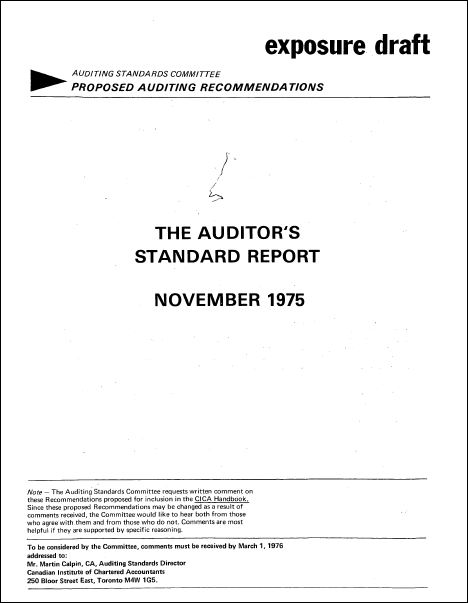
In November 1975, the Auditing Standards Committee of the Canadian Institute of Chartered Accountants issued an exposure draft dealing with The Auditor’s Standard Report. This Exposure Draft was the first stage of a complete updating and revision of the CICA Handbook Section 5500 - The Auditors’ Report.

According to the exposure draft, “The auditor's report is a comprehensive subject and the Committee believes that it would be useful and more efficient to divide present Section 5500 into several separate sections within the Handbook under such section headings as the following: Section 5400 The Auditor’s Standard Report; Section 5500 The Auditor’s Reporting Reservations; Section 5600 Special Reports; and Section 5700 Other Reporting Matters.”

The exposure draft stated that: “The auditor’s standard report is normally presented in two paragraphs. The first ("scope") paragraph identifies the financial statements reported on and contains a reference to the scope and nature of the auditor’s examination. The second ("opinion") paragraph expresses the auditor’s opinion resulting from that examination.” The major changes proposed in the exposure draft were (a) revision of the scope paragraph to state that the auditor’s examination was made in accordance with generally accepted auditing standards; and (b) removal of the two-part opinion concept.


Monday, August 6, 2012

Achieving International Harmonization of Accounting Standards (1975)


In July 1975, the Accounting Research Committee of the Canadian Institute of Chartered Accountants (CICA) issued an exposure draft on International Accounting Standards for inclusion in the CICA Handbook. The exposure draft notes that the CICA is a member of the International Accounting Standards Committee (IASC) whose objectives are “to formulate and publish in the public interest, basic standards to be observed in the presentation of audited accounts and financial statements,and to promote their worldwide acceptance and observance.”

The exposure draft sets out the procedures that the Accounting Research Committee will follow when an International Accounting Standard is issued. In addition, it notes that: “For companies that report in an international environment, it is desirable to disclose that accounting principles generally accepted in Canada have been followed in preparing the financial statements. It is also desirable to disclose conformity with or identify deviations from International Accounting Standards (but not necessarily the effect on the financial statements). Appropriate disclosure would be in the Summary of Accounting Policies.”


Monday, July 30, 2012

Principles-based standards and professional judgment - then and now


At a historic roundtable discussion in New York, the chairman (Charles B. Couchman) stated that: “For many years the leading practitioners of public accountancy have been reducing the practice of accountancy to rules and standards as far as it has been found practical and logical to do so. The elements that make up financial statements have been reduced to standard classifications to the extent permitted by complicated and constantly changing transactions of the business world. Rules have been adopted covering, to a large extent, the various entries affecting the financial classifications. These classifications and these rules have been made widely available through books, articles, addresses and accounting curricula. Practically all the progress that has been made in reducing accountancy to rules and standards has been accomplished by the public accounting profession.”

“If all of the transactions of business were susceptible to analysis into a definite and rigid number of effects that could be analyzed to an extent that would allow exact classification, then rules could be adopted that would cover correctly each one. However, that is not the case. No matter how long one is engaged in an extensive practice of accountancy, he is continually faced  by new and unexpected transactions, each legitimate but each presenting combinations of effects not previously encountered. That is why the sorting of accounting transactions is rigid classifications to which rules and standards may be applied without distortion of fact is a slow process and cannot be otherwise.”

“No fixed rule may be laid down until all of the accounting elements that may fall within its scope have been studied and their effects determined so completely as to bring exact knowledge that the rule, when applied to them, will result in a proper statement of financial facts. Even then the rule must be subject to possible exception, as there is always the possibility that a new and unexpected set of circumstances may arise to which the rigid application of this rule would result in distortion of truth.”

“It is true, not only of accountancy, but of almost every other complicated subject, that the one who has only a smattering of knowledge of it considers that the subject is reasonably simple and that he can readily devise rules governing each phase thereof. To the simple, all things are simple. It is only when one goes deeply into the subject, whatever it may be, that he becomes aware of the complications and the difficulties of proper treatment that is applicable to each element.”

To learn more about the history of the principles versus rules debate, read the transcript of an October 19, 1937 roundtable at the Waldorf-Astoria, New York titled “To What Extent Can the Practice of Accounting Be Reduced to Rules and Standards?” For more information and different perspectives regarding this ongoing debate, refer to previous postings during the past year.