Showing posts with label standard setters. Show all posts

Tuesday, November 6, 2012

PSAAC - What It Is & What It Does


“PSAAC” stands for the Public Sector Accounting and Auditing Committee of the Canadian Institute of Chartered Accountants (CICA). PSAAC was established in 1981, to improve and harmonize public sector accounting and auditing practices. Its creation followed extensive consultation with federal and provincial governments and legislative auditors, and an in-depth CICA study of their financial reporting.
 
That study, Financial Reporting by Governments (1980), found wide disparities in government reporting practices. Government financial statements often reported fragmented and incomplete information, leaving out major operating units and liabilities. So, the financial statement information was inadequate for both decision-making and accountability. In addition, similar transactions were being reported very differently from government to government. As a result, useful comparisons of one government’s financial statements with those of another were almost impossible. The study called for accounting standards tailored to reflect the nature of government objectives and operations, and to meet information needs of the users of government financial statements and reports.
 
In 1991, a tenth anniversary pamphlet was issued on PSAAC - What It Is & What It Does. The pamphlet explains: what it is; why it was formed; how it works; what it’s done; where it’s going; and progress to date. According to the pamphlet: “PSAAC’s role is: To serve the public interest by strengthening accountability in the public sector through developing, recommending and gaining acceptance of accounting and auditing standards of good practice. The Committee issues its recommendations in Public Sector Accounting and Auditing Statements and Guidelines. It also initiates research studies to serve as input to the standard-setting process and to stimulate thought and debate on contentious or complex issues.” An Appendix to the pamphlet lists seven accounting statements, four auditing statements, two auditing guidelines and four research studies issued up to that point in time.

Sunday, September 16, 2012

The First Quarter Century of the GASB (1984–2009): A Perspective on Standard Setting


The Governmental Accounting Standards Board (GASB) was established in April 1984 as the authoritative accounting standard-setting body for state and local governmental entities in the United States. There are over 87,000 state and local entities in the country and for the most part these entities are required to comply with the generally accepted accounting principles established by the GASB. Therefore, the standards promulgated by the GASB are significant. On June 30, 2009, the GASB completed its 25th year of standard setting. Because of its influence and the importance of its mission, a better understanding of the GASB and its accomplishments during its first 25 years of existence may be helpful.
 
Two research papers (Part 1 and Part 2) provide a complete sequential treatment of the GASB’s operational history through the end of its first quarter century. The first paper begins with an historical perspective about municipal accounting issues from colonial times to 1934. The origin of professional self-determining standards is the feature of the second paper, identifying standard-setting bodies that contributed to municipal accounting from 1934 to 1984. The early activities of the GASB are then reviewed. Two appendices are provided to detail the composition of the Board during its first quarter century, along with biographical information about the early Board members and later Chair and Vice Chair personnel.
 
The first paper concludes with a review of the relationship of other governmental standard setting bodies at the federal level and the international level. The second paper provides an overview of the future challenges faced by the GASB and supplies a digest of the standards including appendix and a synoptic summary of the standards the Board has promulgated by topic and by standard number.
 
Gary J. Previts
For more information, read the article “The First Quarter Century of the GASB (1984–2009): A Perspective on Standard Setting” by Helen M. Roybark, Edward N. Coffman and Gary J. Previts.
 
Part 1 of this article was published in ABACUS (Volume 48, Issue 1, pages 1–30, March 2012) and Part 2 was published in ABACUS (Volume 48, Issue 2, pages 147–198, June 2012).


In addition, refer to the article “The GASB Marks 25 Years of Standards-Setting” published in June 2009 on the GASB website.
 

Sunday, August 26, 2012

Paul Pacter: Profile and Interview


Accountancy Age online published an April 2010 article called “Profile: Paul Pacter, international standard setter.” The article states that, although some people may not recognise his name, Paul Pacter is one of the most influential men in the history of international accounting standards."  Since 2000, he has played a variety of roles including director of standards for small and medium-sized entities at the International Accounting Standards Board and director at the global IFRS office for Deloitte in Hong Kong. During the 1990s, he served as staff member at the International Accounting Standards Committee working on projects including financial instruments, interim financial reporting, segment reporting, discontinuing operations, extractive industries, agriculture, and electronic financial reporting. From 1984-1989, he was vice chairman of the advisory council to the US Governmental Accounting Standards Board.
 
On July 12, 2011, an Interview with Paul Pacter was conducted in New York City by James Stocker for the Securities and Exchange Commission Historical Society’s virtual museum and archive on the history of financial regulation. A 53-page transcript of that interview notes that, during the 2000s, he also set up a very popular website (www.iasplus.com) for accountants involved in international accounting standards. Pacter comments that: “This was done for Deloitte. We just had an idea that there ought to be someplace out on the Internet where all sorts of information about international accounting standards was available. The old IASC didn’t have much of a website, although I did that too, I taught myself the HTML and the graphics and how to do FTP. Deloitte said, “Why don’t you set something up for IASs?” We opened shop as a free site. We opened the door in December 2000. Visitor numbers grew dramatically. When I left Deloitte in June 2010, we were getting 60,000 to 70,000 visitors a week – unique visitors. We had about 1,000 webpages. We had 4,000 downloadable PDF files. It was, and still is, the biggest website in a very narrow area of interest, international accounting standards.”
 
Looking back at a long career, Pacter comments: “...I must just say out of respect for the U.S. SEC, they’ve been a great contributor to accounting standards. They have stayed out of the development of the standards. They’ve encouraged and prodded and commented. They’ve insisted on high quality implementation. For that, I say I have the greatest respect for the commission and for their counterparts around the world. We don’t want politics setting accounting standards. We don’t want politicians setting accounting standards any more than I want them telling my surgeon how to do my surgery. Set the broad principles and let the private sector do the job. The commission has done that, and I thank them for that.”

Wednesday, August 15, 2012

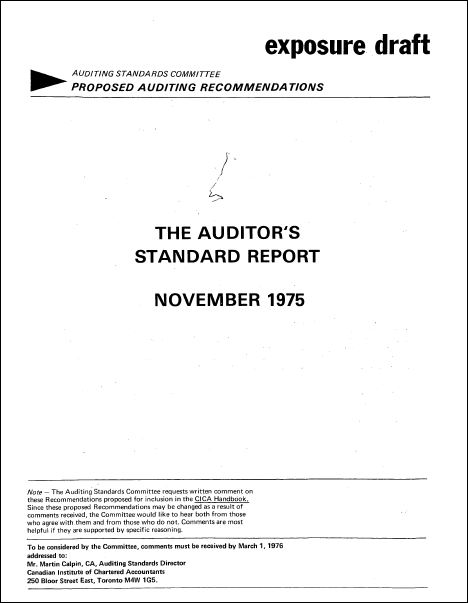
The Auditor’s Standard Report (1975)


In November 1975, the Auditing Standards Committee of the Canadian Institute of Chartered Accountants issued an exposure draft dealing with The Auditor’s Standard Report. This Exposure Draft was the first stage of a complete updating and revision of the CICA Handbook Section 5500 - The Auditors’ Report.

According to the exposure draft, “The auditor's report is a comprehensive subject and the Committee believes that it would be useful and more efficient to divide present Section 5500 into several separate sections within the Handbook under such section headings as the following: Section 5400 The Auditor’s Standard Report; Section 5500 The Auditor’s Reporting Reservations; Section 5600 Special Reports; and Section 5700 Other Reporting Matters.”

The exposure draft stated that: “The auditor’s standard report is normally presented in two paragraphs. The first ("scope") paragraph identifies the financial statements reported on and contains a reference to the scope and nature of the auditor’s examination. The second ("opinion") paragraph expresses the auditor’s opinion resulting from that examination.” The major changes proposed in the exposure draft were (a) revision of the scope paragraph to state that the auditor’s examination was made in accordance with generally accepted auditing standards; and (b) removal of the two-part opinion concept.


Monday, July 30, 2012

Principles-based standards and professional judgment - then and now


At a historic roundtable discussion in New York, the chairman (Charles B. Couchman) stated that: “For many years the leading practitioners of public accountancy have been reducing the practice of accountancy to rules and standards as far as it has been found practical and logical to do so. The elements that make up financial statements have been reduced to standard classifications to the extent permitted by complicated and constantly changing transactions of the business world. Rules have been adopted covering, to a large extent, the various entries affecting the financial classifications. These classifications and these rules have been made widely available through books, articles, addresses and accounting curricula. Practically all the progress that has been made in reducing accountancy to rules and standards has been accomplished by the public accounting profession.”

“If all of the transactions of business were susceptible to analysis into a definite and rigid number of effects that could be analyzed to an extent that would allow exact classification, then rules could be adopted that would cover correctly each one. However, that is not the case. No matter how long one is engaged in an extensive practice of accountancy, he is continually faced  by new and unexpected transactions, each legitimate but each presenting combinations of effects not previously encountered. That is why the sorting of accounting transactions is rigid classifications to which rules and standards may be applied without distortion of fact is a slow process and cannot be otherwise.”

“No fixed rule may be laid down until all of the accounting elements that may fall within its scope have been studied and their effects determined so completely as to bring exact knowledge that the rule, when applied to them, will result in a proper statement of financial facts. Even then the rule must be subject to possible exception, as there is always the possibility that a new and unexpected set of circumstances may arise to which the rigid application of this rule would result in distortion of truth.”

“It is true, not only of accountancy, but of almost every other complicated subject, that the one who has only a smattering of knowledge of it considers that the subject is reasonably simple and that he can readily devise rules governing each phase thereof. To the simple, all things are simple. It is only when one goes deeply into the subject, whatever it may be, that he becomes aware of the complications and the difficulties of proper treatment that is applicable to each element.”

To learn more about the history of the principles versus rules debate, read the transcript of an October 19, 1937 roundtable at the Waldorf-Astoria, New York titled “To What Extent Can the Practice of Accounting Be Reduced to Rules and Standards?” For more information and different perspectives regarding this ongoing debate, refer to previous postings during the past year.