In 1891, Rogers expanded his chocolate operation to the company's current heritage storefront on Government Street in Victoria and the rest, as they say, is history. Today, there are 8 retail stores, several hundred wholesale outlets that ship to over 50 countries, and a 20,000 square-foot factory. For more information, visit the History webpage. Also, see the timeline on A Brief History of Chocolate from 250BC to 2010, and view the Rogers Videos on YouTube.
Showing posts with label accounting history. Show all posts
Friday, December 21, 2012
Rogers’ Chocolates since 1885
In 1891, Rogers expanded his chocolate operation to the company's current heritage storefront on Government Street in Victoria and the rest, as they say, is history. Today, there are 8 retail stores, several hundred wholesale outlets that ship to over 50 countries, and a 20,000 square-foot factory. For more information, visit the History webpage. Also, see the timeline on A Brief History of Chocolate from 250BC to 2010, and view the Rogers Videos on YouTube.
Thursday, December 13, 2012
A short history of female Chartered Accountants (CAs) in Canada
As the above chart shows, women in Canada have come a long, long way since their beginnings in the CA profession. To gain a true perspective on how far women have come in the profession, it’s enlightening to look back — way back — to 1922, when Mercy Ellen Crehan and Florence Eulalie Herkins became the first women to be admitted to membership. It seems the welcome was not exactly glorious: in the June 1966 issue of CAmagazine (then called The Canadian Chartered Accountant), FCA and former federal MP Ellen Fairclough wrote that one of the women “found it necessary to ‘defect’ to the United States to earn a living in her chosen profession.”
Over the next decades, the number of women in the profession grew ever so slowly. As Steve Brearton wrote in “A century of CAmagazine” (June/July 2011), “Even the opportunities afforded women during the Second World War to demonstrate their obvious competence barely opened doors.” By 1966, there were still only 125 women members — a situation that Fairclough bemoaned. “[The number] leaves much to be desired, particularly when there is such a demand, even an urgent need, to fill the vacancies which appear to be increasing in number in the profession. The question arises whether the profession is to be deprived of the services of qualified people because of age-old prejudices and inhibitions.”
By the mid-1970s, things were slowly starting to move. In 1976, Pamela Jermey became the first woman to garner top marks on the Uniform Final Examination (UFE). And in 1979, women took all three top spots on the UFE honour role. In a January 1980 CAmagazine editorial, Nelson Luscombe wrote, “There’s every indication that [women’s] presence will continue to increase, both in numbers and significance.” He cited an article in the same issue predicting that females would begin to be appointed to partnership in the early 1980s and that by the end of the first decade of the next century, the proportion “should reach 30%.” That last prediction did not come true. Is it time to make another?
Sunday, November 18, 2012
Report on Specialization in the Canadian Chartered Accountancy Profession – December 1981
The 148-page Report of the Committee to Study
Specialization in the Canadian Chartered Accountancy Profession was issued in December 1981. The
Chairman’s Letter by W.D. Grace, FCA, states that: “The issue of specialization
within the profession is not easily resolved. The Committee believes that the
recommendations for a voluntary structured plan of specialization would prove
to be of significant long term benefit to the Canadian public and to all
members of the chartered accountancy profession. The Committee has addressed
the issue of specialization through a lengthy process of research, discussion,
and debate and by consideration of the present de facto situation and the
specialty experiences of other accounting bodies and other professions.” The
Committee recommended that four specific areas of practice be initially
recognized as specialties: taxation, insolvency, business valuation and
computer audit.
According to the booklet called Another Great Leap - CA•Designated Specialists, Chartered Accountants in Canada now have access to six profession-endorsed specialist designations, some offered directly by the Canadian Institute of Chartered Accountants (CICA) and others through organizations that have been accredited by the CICA. Currently, more than 1,000 have earned the advantage of a CA specialist designation. Regardless of the route to the specialist designation, candidates for specialist certification need to demonstrate experience in the field, in addition to completing an evaluation process. As well, specialists must comply with continuing experience and professional development standards to maintain the designation.
For more information, read the CAmagazine article, “Breaking new ground” (published in December 1997, page 2). This article discusses the first specialist designation for investigative and forensic accounting. Also, refer to the CICA website section on CA Specialization and the Institute of Chartered Accountants of Alberta (ICAA) website section on Specialty Designations.
According to the booklet called Another Great Leap - CA•Designated Specialists, Chartered Accountants in Canada now have access to six profession-endorsed specialist designations, some offered directly by the Canadian Institute of Chartered Accountants (CICA) and others through organizations that have been accredited by the CICA. Currently, more than 1,000 have earned the advantage of a CA specialist designation. Regardless of the route to the specialist designation, candidates for specialist certification need to demonstrate experience in the field, in addition to completing an evaluation process. As well, specialists must comply with continuing experience and professional development standards to maintain the designation.
For more information, read the CAmagazine article, “Breaking new ground” (published in December 1997, page 2). This article discusses the first specialist designation for investigative and forensic accounting. Also, refer to the CICA website section on CA Specialization and the Institute of Chartered Accountants of Alberta (ICAA) website section on Specialty Designations.
Labels:
accounting history,
bankruptcy,
business valuation,
CICA,
e-book,
ICAA,
insolvency,
IT,
specialization,
taxation
Tuesday, November 6, 2012
PSAAC - What It Is & What It Does
“PSAAC” stands for the Public Sector Accounting and Auditing
Committee of the Canadian Institute of Chartered Accountants (CICA). PSAAC was
established in 1981, to improve and harmonize public sector accounting and
auditing practices. Its creation followed extensive consultation with federal
and provincial governments and legislative auditors, and an in-depth CICA study
of their financial reporting.
That study, Financial
Reporting by Governments (1980), found wide disparities in government
reporting practices. Government financial statements often reported fragmented
and incomplete information, leaving out major operating units and liabilities.
So, the financial statement information was inadequate for both decision-making
and accountability. In addition, similar transactions were being reported very
differently from government to government. As a result, useful comparisons of
one government’s financial statements with those of another were almost
impossible. The study called for accounting standards tailored to reflect the
nature of government objectives and operations, and to meet information needs
of the users of government financial statements and reports.
In 1991, a tenth anniversary pamphlet was issued on PSAAC - What It Is & What It Does. The
pamphlet explains: what it is; why it was formed; how it works; what it’s done;
where it’s going; and progress to date. According to the pamphlet: “PSAAC’s role
is: To serve the public interest by strengthening accountability in the public
sector through developing, recommending and gaining acceptance of accounting
and auditing standards of good practice. The Committee issues its
recommendations in Public Sector Accounting and Auditing Statements and
Guidelines. It also initiates research studies to serve as input to the
standard-setting process and to stimulate thought and debate on contentious or
complex issues.” An Appendix to the pamphlet lists seven accounting statements,
four auditing statements, two auditing guidelines and four research studies
issued up to that point in time.
Tuesday, October 30, 2012
A Review of Bookkeeping and Accounting in 1945
A 1945 Vocational Guidance Film on Bookkeeping and Accounting is available for viewing online at the SEC Historical Society website. This entertaining 10-minute video was provided by courtesy of the Prelinger Archives, United States Library of Congress. It discusses a variety of matters including the household budget book, business bookkeeping, the role of the bookkeeper compared to that of the accountant, an accounting department, calculating and bookkeeping machines, cost accounting, special investigations, preparing tax returns and business principles. It also distinguishes a private accountant from a public accountant (such as a CPA) who should have a pleasing personality, a strong moral character and legible handwriting.
Monday, October 15, 2012
50 years ago in the October 1962 CAmagazine
The October 1962 edition of CAmagazine discussed the “Need for reform in the Bankruptcy Act.” It stated that: “Bankruptcies and their attendant losses have become a most pressing problem…. A tremendous volume of business is presently conducted in Canada by ‘thin’ corporations — where the shareholders have very little of their own money in the company. [One] might well remark that such a corporation should not be given credit…. Our present Bankruptcy Act … displays no recognition, whatsoever, of the need of a separate set of ‘ground rules’ in dealing with corporations.”
Also, read about the “60th Annual Conference” (from the summary of the CICA annual meeting in Fredericton, New Brunswick) and “The new management theories make for poor performance” (a summary of “Executives who can’t manage,” from The Atlantic Monthly, July 1962).
AICPA - Evolution of a Profession
The American Institute of Certified Public Accountants (AICPA) was formed in 1887 and is celebrating its 125th anniversary in 2012. As part of the celebration, this short video (about 6 minutes), called “Evolution of a Profession,” reviews the history of the accounting profession from its origins 8,000 years ago to present day.
Labels:
accounting history,
AICPA,
audio-video,
centennial,
chronology,
CPA.,
digital archives
Wednesday, October 10, 2012
The Accountant Who Changed the World
The birth of accounting rocked the world 500 years ago. In the 1400s, much of Europe was still using Roman numerals and finding it really hard to easily add or subtract. Arabic numerals (1, 2, 3, 4, etc.) started catching on and' with those numbers, merchants in Venice developed a revolutionary system we now call “double-entry” bookkeeping.
Every transaction gets entered twice in financial records. If one day, you sold three gold coins' worth of pepper, you would write that the amount of cash you had went up by three gold coins. You would also write in that the amount of pepper you had went down by three gold coins' worth. Before double-entry, people just kept diaries and counted their money at the end of the day. This innovation allowed merchants to see every aspect of their business in neat little rows.
Luca Pacioli was a monk, magician and lover of numbers. He discovered this bookkeeping in Venice. In 1494, he wrote a huge math encyclopedia and included an instructional section on double-entry bookkeeping. Thanks to the new printing press, his book was mass produced and became a hit. One of the first readers was Leonardo da Vinci, who at the time was painting The Last Supper. Pacioli’s encyclopedia covered the mathematics of perspective painting which fascinated da Vinci.
Read the article “The
Accountant Who Changed the World” and listen
to the full story (about 5 minutes) at NPR online.
Sunday, September 30, 2012
Should Accounting Standards be Principles or Rules?
In a recently-published article, Sir David Tweedie
notes that: “Forty-odd years ago, as a CA apprentice, I didn't have to study
accounting standards because there weren’t any! There was one major standard –
the true and fair view – augmented by accepted practice.” According to Tweedie,
two disputed takeover bids soon changed that. The President of the Institute of
Chartered Accountants in England and Wales (ICAEW), Sir Ronald Leach, senior
partner of Peat Marwick & Co., and Professor Edward Stamp
of Edinburgh University became embroiled in a public argument in the pages of The Times over the state of British
financial reporting.
“Professor Stamp argued that for any
major company, there would be a million ways which you could show a true and
fair view, and that this was totally unacceptable. Sir Ronald reacted with
alacrity, and together with the other Institutes (including a rather reluctant
ICAS), agreed to form the Accounting Standards Steering Committee in 1969.
Pressured by the Government, the Committee looked for a quick win and came upon
a research paper of the ICAEW dealing with Associated Companies. This was
rapidly turned into the Statement of Standard Accounting Practice 1. While to
accountants such a topic would be a bizarre choice for the first standard,
rather than what became SSAP2 – Accounting Policies – the profession needed to
show it.”
“The argument continues over whether
standards in financial reporting can best be governed by clear and detailed
rules, or by principles and judgement could act quickly in a time of crisis.
Since then, we have seen the SSAPs gradually replaced with Financial Reporting
Standards and latterly by International Financial Reporting Standards (IFRS).
These standards have become more and more complex.”
“Accounting is not rocket science.
Writing a standard to deal with 80 per cent of the problems takes only a few
pages, yet if our profession requires every avenue to be explored, then it can
run into hundreds. ICAS is just completing a judgement framework
to assist professionals who are unsure what exactly judgement involves. If you
have been trained in what I term ‘search-engine’ accounting – looking up the
answer in a massive book of rules –judgement can be scary.”
“The profession is at a crossroads,
and the more we head down the rules route the harder it will be to pull back to
simpler, more clearly expressed principle-based standards.” Read the article “Should Accounting Standards be
Principles or Rules?” by Sir David Tweedie, President of
the Institute of Chartered Accountants of Scotland (ICAS), as well as previous
postings regarding the Principles versus Rules
debate.
Sunday, September 16, 2012
The First Quarter Century of the GASB (1984–2009): A Perspective on Standard Setting
The Governmental Accounting Standards Board (GASB) was
established in April 1984 as the authoritative accounting standard-setting body
for state and local governmental entities in the United States. There are over
87,000 state and local entities in the country and for the most part these
entities are required to comply with the generally accepted accounting
principles established by the GASB. Therefore, the standards promulgated by the
GASB are significant. On June 30, 2009, the GASB completed its 25th year of
standard setting. Because of its influence and the importance of its mission, a
better understanding of the GASB and its accomplishments during its first 25
years of existence may be helpful.
Two research papers (Part 1 and Part 2) provide a complete sequential
treatment of the GASB’s operational history through the end of its first
quarter century. The first paper begins with an historical perspective about
municipal accounting issues from colonial times to 1934. The origin of
professional self-determining standards is the feature of the second paper,
identifying standard-setting bodies that contributed to municipal accounting
from 1934 to 1984. The early activities of the GASB are then reviewed. Two
appendices are provided to detail the composition of the Board during its first
quarter century, along with biographical information about the early Board
members and later Chair and Vice Chair personnel.
The first paper concludes with a review of the relationship
of other governmental standard setting bodies at the federal level and the
international level. The second paper provides an overview of the future
challenges faced by the GASB and supplies a digest of the standards including
appendix and a synoptic summary of the standards the Board has promulgated by
topic and by standard number.
| Gary J. Previts |
For more information, read the
article “The First Quarter Century of the GASB (1984–2009): A Perspective on
Standard Setting” by Helen M. Roybark, Edward N. Coffman and Gary
J. Previts.
Part 1 of this article was published in ABACUS (Volume 48, Issue 1, pages 1–30, March 2012) and Part 2 was published in ABACUS (Volume 48,
Issue 2, pages 147–198, June 2012).
In addition, refer to the article “The GASB Marks 25 Years of Standards-Setting” published in June 2009 on the GASB website.
Sunday, August 26, 2012
Paul Pacter: Profile and Interview
Accountancy Age online published an
April 2010 article called “Profile:
Paul Pacter, international standard setter.” The article states that, although
some people may not recognise his name, Paul Pacter is one of the most
influential men in the history of international accounting standards." Since 2000, he has played a variety of roles
including director of standards for small and medium-sized entities at the
International Accounting Standards Board and director at the global IFRS office
for Deloitte in Hong Kong. During the 1990s, he served as staff member at the
International Accounting Standards Committee working on projects including
financial instruments, interim financial reporting, segment reporting,
discontinuing operations, extractive industries, agriculture, and electronic
financial reporting. From 1984-1989, he was vice chairman of the advisory
council to the US Governmental Accounting Standards Board.
On July 12, 2011, an Interview
with Paul Pacter was conducted in New York City by James Stocker for the Securities and Exchange Commission Historical Society’s virtual museum and archive on the
history of financial regulation. A 53-page transcript of that interview notes
that, during the 2000s, he also set up a very popular website (www.iasplus.com) for accountants involved in
international accounting standards. Pacter comments that: “This was done for
Deloitte. We just had an idea that there ought to be someplace out on the Internet
where all sorts of information about international accounting standards was available.
The old IASC didn’t have much of a website, although I did that too, I taught myself
the HTML and the graphics and how to do FTP. Deloitte said, “Why don’t you set
something up for IASs?” We opened shop as a free site. We opened the door in December
2000. Visitor numbers grew dramatically. When I left Deloitte in June 2010, we
were getting 60,000 to 70,000 visitors a week – unique visitors. We had about
1,000 webpages. We had 4,000 downloadable PDF files. It was, and still is, the
biggest website in a very narrow area of interest, international accounting
standards.”
Looking back at a long career, Pacter comments: “...I must
just say out of respect for the U.S. SEC, they’ve been a great contributor to
accounting standards. They have stayed out of the development of the standards.
They’ve encouraged and prodded and commented. They’ve insisted on high quality
implementation. For that, I say I have the greatest respect for the commission
and for their counterparts around the world. We don’t want politics setting
accounting standards. We don’t want politicians setting accounting standards
any more than I want them telling my surgeon how to do my surgery. Set the
broad principles and let the private sector do the job. The commission has done
that, and I thank them for that.”
Wednesday, August 15, 2012
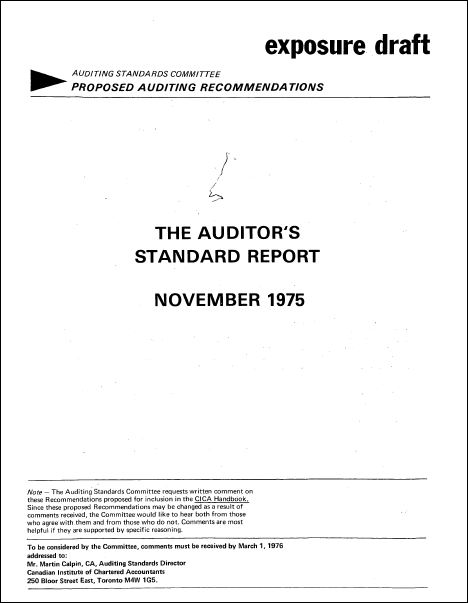
The Auditor’s Standard Report (1975)
In November 1975, the Auditing Standards Committee of the
Canadian Institute of Chartered Accountants issued an exposure draft dealing
with The
Auditor’s Standard Report. This Exposure Draft was the first stage of a
complete updating and revision of the CICA
Handbook Section 5500 - The Auditors’ Report.
According to the exposure draft, “The auditor's report is a
comprehensive subject and the Committee believes that it would be useful and
more efficient to divide present Section 5500 into several separate sections
within the Handbook under such section headings as the following: Section 5400
The Auditor’s Standard Report; Section 5500 The Auditor’s Reporting
Reservations; Section 5600 Special Reports; and Section 5700 Other Reporting
Matters.”
The exposure draft stated that: “The auditor’s standard
report is normally presented in two paragraphs. The first ("scope")
paragraph identifies the financial statements reported on and contains a
reference to the scope and nature of the auditor’s examination. The second
("opinion") paragraph expresses the auditor’s opinion resulting from
that examination.” The major changes proposed in the exposure draft were (a)
revision of the scope paragraph to state that the auditor’s examination was
made in accordance with generally accepted auditing standards; and (b) removal
of the two-part opinion concept.
Monday, August 6, 2012
Achieving International Harmonization of Accounting Standards (1975)
The exposure draft sets out the procedures that the Accounting Research Committee will follow when an International Accounting Standard is issued. In addition, it notes that: “For companies that report in an international environment, it is desirable to disclose that accounting principles generally accepted in Canada have been followed in preparing the financial statements. It is also desirable to disclose conformity with or identify deviations from International Accounting Standards (but not necessarily the effect on the financial statements). Appropriate disclosure would be in the Summary of Accounting Policies.”
Monday, July 30, 2012
Principles-based standards and professional judgment - then and now
At a historic roundtable discussion in New York, the chairman (Charles B. Couchman) stated that: “For many years the leading practitioners of public accountancy have been reducing the practice of accountancy to rules and standards as far as it has been found practical and logical to do so. The elements that make up financial statements have been reduced to standard classifications to the extent permitted by complicated and constantly changing transactions of the business world. Rules have been adopted covering, to a large extent, the various entries affecting the financial classifications. These classifications and these rules have been made widely available through books, articles, addresses and accounting curricula. Practically all the progress that has been made in reducing accountancy to rules and standards has been accomplished by the public accounting profession.”
“If all of the transactions of business were susceptible to analysis into a definite and rigid number of effects that could be analyzed to an extent that would allow exact classification, then rules could be adopted that would cover correctly each one. However, that is not the case. No matter how long one is engaged in an extensive practice of accountancy, he is continually faced by new and unexpected transactions, each legitimate but each presenting combinations of effects not previously encountered. That is why the sorting of accounting transactions is rigid classifications to which rules and standards may be applied without distortion of fact is a slow process and cannot be otherwise.”
“No fixed rule may be laid down until all of the accounting elements that may fall within its scope have been studied and their effects determined so completely as to bring exact knowledge that the rule, when applied to them, will result in a proper statement of financial facts. Even then the rule must be subject to possible exception, as there is always the possibility that a new and unexpected set of circumstances may arise to which the rigid application of this rule would result in distortion of truth.”
“It is true, not only of accountancy, but of almost every other complicated subject, that the one who has only a smattering of knowledge of it considers that the subject is reasonably simple and that he can readily devise rules governing each phase thereof. To the simple, all things are simple. It is only when one goes deeply into the subject, whatever it may be, that he becomes aware of the complications and the difficulties of proper treatment that is applicable to each element.”
To learn more about the history of the principles versus rules debate, read the transcript of an October 19, 1937 roundtable at the Waldorf-Astoria, New York titled “To What Extent Can the Practice of Accounting Be Reduced to Rules and Standards?” For more information and different perspectives regarding this ongoing debate, refer to previous postings during the past year.
Friday, July 6, 2012
Generally Accepted Auditing Standards: Audit Evidence – 1977
In February 1975, the CICA’s Auditing Standards Committee (AuSC) proposed, subject to comments received following exposure, to publish the contents of an Exposure Draft as CICA Handbook: Section 5100 - Generally Accepted Auditing Standards. In July 1976, the AuSC issued a 32-page Exposure Draft on “Internal Control” (for inter-related Sections 5200 to 5230).
Then, in May 1977, the AuSC issued a 12-page Exposure Draft on “Audit Evidence” (for Sections 5300). This material was intended to provide guidance, in general terms, as to the attributes of audit evidence and the manner in which the auditor obtains and evaluates such evidence to adhere to field work standard (iii) within generally accepted auditing standards. Field work standard (iii) states: “"Sufficient appropriate audit evidence should be obtained, by such means as inspection, observation, enquiry, confirmation, computation and analysis, to afford a reasonable basis to support the content of the report.”
The Exposure Draft emphasized that “The auditor is concerned with audit evidence in all phases of his audit engagement, from the planning stage, through the study and evaluation of internal control including the performance of compliance auditing procedures, to the performance of substantive auditing procedures.” It addressed the following matters: Introduction and Definition; Knowledge of the Business; Necessity for Performing Substantive Auditing Procedures; Sufficiency and Appropriateness of Evidence; Methods of Obtaining Evidence; Timing of Auditing Procedures; Errors and Irregularities; and Evaluation of Audit Evidence. In this regard, “The auditor relies on his professional judgment [emphasis added] in deciding which procedures will give him sufficient appropriate audit evidence. He evaluates the audit evidence gathered to determine the content of his report.”
Thursday, June 21, 2012
Generally Accepted Auditing Standards: Internal Control – 1976
The following year, in July 1976, the AuSC issued a 32-page Exposure Draft on “Internal Control.” This material (for inter-related Sections 5200 to 5230) was intended to provide an explanation, in general terms, of what the auditor should do in order to comply with field work standard (ii) within Generally Accepted Auditing Standards (GAAS). Field work standard (ii) states: “There should be an appropriately organized study and evaluation of those internal controls on which the auditor subsequently relies in determining the nature, extent and timing of auditing procedures."
The Exposure Draft addressed the following matters: Management’s objectives; Basic components of internal control systems; Auditor's objective regarding internal control; Auditor's approach – overview; Auditor's study and evaluation; and, Relationship to substantive auditing procedures. A decision tree was provided in Appendix A on page 32 (refer to the graphic above). It is noteworthy that the Exposure Draft also mentioned that the AuSC was working on a project to provide a similar explanation with respect to field work standard (iii) - Audit Evidence.
Thursday, June 14, 2012
Andersen, Auditing and Atonement
Ten years ago, Arthur Andersen was forced to surrender its licences in the United States after the Enron scandal, precipitating its global collapse. December 2011 marked 10 years since Enron, the Texas energy company, filed for bankruptcy after perpetrating one of the world's biggest business frauds. More significantly for the accounting profession, May 2012 marks a decade since the Enron indictment in the United States, and the beginning of the end for the well-respected Arthur Andersen, one of what was then the Big Five accounting firms.
The firm was convicted of obstructing justice by destroying thousands of documents related to its work for Enron. While the ruling was overturned in 2005 on technical grounds, it came too late to resuscitate the brand. For the profession, the scandal drew wide scrutiny on the supposed compromised position of large firms that audit the books of clients to whom they also provide consultancy services.
For a look back on the past decade of reactions, reforms and soul-searching in the accounting profession, read the article “ANDERSEN, AUDITING AND ATONEMENT: The accounting profession 10 years after Enron” by George W. Russell at GAA Accounting online.
Friday, June 8, 2012
CICA - Good Audit Working Papers: An Audit Technique Study (1970)
According to the Foreword in a 1970 CICA Audit Technique Study,
Gertrude Mulcahy, FCA, Director of Research, states: “The preparation of audit
working papers is an essential part of audit work. However, because they are
part of the normal routine followed in all audit engagements, there is a very
real danger that the basic purposes of preparing such papers may be overlooked,
with the result that the papers may fail to achieve these purposes.”
In this 35-page study, called Good Audit Working Papers, the Study Group provides a statement of
the purposes of working papers and develops what they believe to be a systematic
approach to the content, organization, review and retention of good audit
working papers as a basis for practitioners to evaluate their own procedures.
During the formulation of this approach, the Study Group also examined
questions relating to the ownership of working papers and the preparation of
working papers for non-audit engagements.
Basic principles to assist in the resolution of these
questions are also set out. In addition, several suggestions on the preparation
of good audit working papers are included in the Appendices. Gerald Trites, FCA
is acknowledged for his work on various drafts of this landmark Study published more than 40 years ago.
Friday, May 11, 2012
AICPA 125th Anniversary: Overcoming Challenges
According to the AICPA Insights blog, the history of the profession includes a long tradition of successfully overcoming challenges. “Throughout our nearly 125 years, we have been a proactive profession that seeks out opportunities for growth and improvement. The latest example is CPA Horizons 2025, a landmark project that continues the valuable work of the profession’s Vision Process in the late 1990s and charts a course for the profession over the next 15 years. Among other key areas, Horizons 2025 focused on the increasing impact that technology will have on our world and on our profession. Since technology can automate so many of the tasks that we perform, it has allowed us to raise our game and reinforce our roles as trusted business advisors.”
In celebration of its 125th anniversary, the AICPA will
highlight the CPA profession’s financial literacy expertise in a consumer-focused
book. The book content will be a collection of personal essays showcasing
the many ways CPAs transform financial lives. In this regard, the AICPA is
looking for real-world saving and spending stories and tales of both money
struggles and triumph to help families get a handle on their finances and teach
good habits to children. The goal is to publish the book in the same style as
the Chicken Soup for the Soul series
in Fall 2012. That will coincide with the AICPA’s 125th anniversary and take
advantage of the moment to highlight the CPA profession in the public. This
book will be the AICPA’s first consumer publication and the first book
published as part of the “360
Degrees of Financial Literacy” program.
Labels:
accounting history,
AICPA,
chronology,
CPA.,
future vision,
professional services
Friday, May 4, 2012
Indiana CPAs - In the beginning …
Before there was a tax code (1913), before there was a Department of Labor (1913), before the SEC (1935) and before the PCAOB (2002), even before audits, there were CPAs (New York – 1896). How did the profession rise to the level of prominence in business without license to do something specific?
What were the requirements in 1915? Well … you had to be 21 years old, a high school graduate, have three years of experience as a professional accountant and submit “proof” of all of that to the newly created “state board of certified accountants”. Then, per Indiana law, “shall be granted without examination a certificate authorizing him to practice as a certified public accountant”. Of course this had to be done within 90 days. After that you would have had to take an examination. The early CPAs were grandfathered. That is how the profession got its start.
The first accounting standards were issued somewhere around 1938, and by 1959 there were 51 pronouncements known as Accounting Research Bulletins – this eventually became GAAP. The pronouncements were issued by the Committee on Accounting Procedure (CAP). The first auditing standards were issued in 1939 by the American Institute of Accountants committee on auditing procedure. In 1941, the SEC mandated that the auditor’s report had to be made in accordance with GAAP (they didn’t do that in 1935 because there was no GAAP).
To learn more, read the article “In the beginning …” posted on the Indiana CPA Society blog on February 16, 2012 by Gary Bolinger.
Labels:
accounting,
accounting history,
accounting standards,
AICPA,
chronology,
CPA.,
Indiana,
legislation-regulation,
PCAOB,
SEC,
taxation
Subscribe to:
Posts (Atom)