Showing posts with label professional judgment. Show all posts

Sunday, September 30, 2012

Should Accounting Standards be Principles or Rules?


In a recently-published article, Sir David Tweedie notes that: “Forty-odd years ago, as a CA apprentice, I didn't have to study accounting standards because there weren’t any! There was one major standard – the true and fair view – augmented by accepted practice.” According to Tweedie, two disputed takeover bids soon changed that. The President of the Institute of Chartered Accountants in England and Wales (ICAEW), Sir Ronald Leach, senior partner of Peat Marwick & Co., and Professor Edward Stamp of Edinburgh University became embroiled in a public argument in the pages of The Times over the state of British financial reporting.
 
“Professor Stamp argued that for any major company, there would be a million ways which you could show a true and fair view, and that this was totally unacceptable. Sir Ronald reacted with alacrity, and together with the other Institutes (including a rather reluctant ICAS), agreed to form the Accounting Standards Steering Committee in 1969. Pressured by the Government, the Committee looked for a quick win and came upon a research paper of the ICAEW dealing with Associated Companies. This was rapidly turned into the Statement of Standard Accounting Practice 1. While to accountants such a topic would be a bizarre choice for the first standard, rather than what became SSAP2 – Accounting Policies – the profession needed to show it.”
 
“The argument continues over whether standards in financial reporting can best be governed by clear and detailed rules, or by principles and judgement could act quickly in a time of crisis. Since then, we have seen the SSAPs gradually replaced with Financial Reporting Standards and latterly by International Financial Reporting Standards (IFRS). These standards have become more and more complex.”
 
“Accounting is not rocket science. Writing a standard to deal with 80 per cent of the problems takes only a few pages, yet if our profession requires every avenue to be explored, then it can run into hundreds. ICAS is just completing a judgement framework to assist professionals who are unsure what exactly judgement involves. If you have been trained in what I term ‘search-engine’ accounting – looking up the answer in a massive book of rules –judgement can be scary.”
 
“The profession is at a crossroads, and the more we head down the rules route the harder it will be to pull back to simpler, more clearly expressed principle-based standards.” Read the article “Should Accounting Standards be Principles or Rules?” by Sir David Tweedie, President of the Institute of Chartered Accountants of Scotland (ICAS), as well as previous postings regarding the Principles versus Rules debate.

Wednesday, August 15, 2012

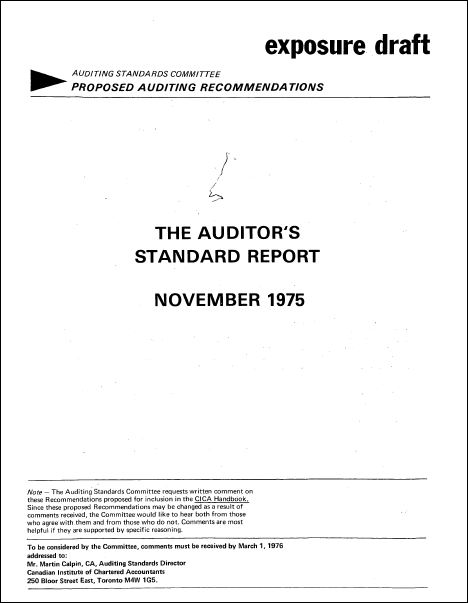
The Auditor’s Standard Report (1975)


In November 1975, the Auditing Standards Committee of the Canadian Institute of Chartered Accountants issued an exposure draft dealing with The Auditor’s Standard Report. This Exposure Draft was the first stage of a complete updating and revision of the CICA Handbook Section 5500 - The Auditors’ Report.

According to the exposure draft, “The auditor's report is a comprehensive subject and the Committee believes that it would be useful and more efficient to divide present Section 5500 into several separate sections within the Handbook under such section headings as the following: Section 5400 The Auditor’s Standard Report; Section 5500 The Auditor’s Reporting Reservations; Section 5600 Special Reports; and Section 5700 Other Reporting Matters.”

The exposure draft stated that: “The auditor’s standard report is normally presented in two paragraphs. The first ("scope") paragraph identifies the financial statements reported on and contains a reference to the scope and nature of the auditor’s examination. The second ("opinion") paragraph expresses the auditor’s opinion resulting from that examination.” The major changes proposed in the exposure draft were (a) revision of the scope paragraph to state that the auditor’s examination was made in accordance with generally accepted auditing standards; and (b) removal of the two-part opinion concept.


Monday, July 30, 2012

Principles-based standards and professional judgment - then and now


At a historic roundtable discussion in New York, the chairman (Charles B. Couchman) stated that: “For many years the leading practitioners of public accountancy have been reducing the practice of accountancy to rules and standards as far as it has been found practical and logical to do so. The elements that make up financial statements have been reduced to standard classifications to the extent permitted by complicated and constantly changing transactions of the business world. Rules have been adopted covering, to a large extent, the various entries affecting the financial classifications. These classifications and these rules have been made widely available through books, articles, addresses and accounting curricula. Practically all the progress that has been made in reducing accountancy to rules and standards has been accomplished by the public accounting profession.”

“If all of the transactions of business were susceptible to analysis into a definite and rigid number of effects that could be analyzed to an extent that would allow exact classification, then rules could be adopted that would cover correctly each one. However, that is not the case. No matter how long one is engaged in an extensive practice of accountancy, he is continually faced  by new and unexpected transactions, each legitimate but each presenting combinations of effects not previously encountered. That is why the sorting of accounting transactions is rigid classifications to which rules and standards may be applied without distortion of fact is a slow process and cannot be otherwise.”

“No fixed rule may be laid down until all of the accounting elements that may fall within its scope have been studied and their effects determined so completely as to bring exact knowledge that the rule, when applied to them, will result in a proper statement of financial facts. Even then the rule must be subject to possible exception, as there is always the possibility that a new and unexpected set of circumstances may arise to which the rigid application of this rule would result in distortion of truth.”

“It is true, not only of accountancy, but of almost every other complicated subject, that the one who has only a smattering of knowledge of it considers that the subject is reasonably simple and that he can readily devise rules governing each phase thereof. To the simple, all things are simple. It is only when one goes deeply into the subject, whatever it may be, that he becomes aware of the complications and the difficulties of proper treatment that is applicable to each element.”

To learn more about the history of the principles versus rules debate, read the transcript of an October 19, 1937 roundtable at the Waldorf-Astoria, New York titled “To What Extent Can the Practice of Accounting Be Reduced to Rules and Standards?” For more information and different perspectives regarding this ongoing debate, refer to previous postings during the past year.

Friday, July 6, 2012

Generally Accepted Auditing Standards: Audit Evidence – 1977


In February 1975, the CICA’s Auditing Standards Committee (AuSC) proposed, subject to comments received following exposure, to publish the contents of an Exposure Draft as CICA Handbook: Section 5100 - Generally Accepted Auditing Standards. In July 1976, the AuSC issued a 32-page Exposure Draft on “Internal Control” (for inter-related Sections 5200 to 5230).

Then, in May 1977, the AuSC issued a 12-page Exposure Draft on “Audit Evidence” (for Sections 5300). This material was intended to provide guidance, in general terms, as to the attributes of audit evidence and the manner in which the auditor obtains and evaluates such evidence to adhere to field work standard (iii) within generally accepted auditing standards. Field work standard (iii) states: “"Sufficient appropriate audit evidence should be obtained, by such means as inspection, observation, enquiry, confirmation, computation and analysis, to afford a reasonable basis to support the content of the report.”

The Exposure Draft emphasized that “The auditor is concerned with audit evidence in all phases of his audit engagement, from the planning stage, through the study and evaluation of internal control including the performance of compliance auditing procedures, to the performance of substantive auditing procedures.” It addressed the following matters: Introduction and Definition; Knowledge of the Business; Necessity for Performing Substantive Auditing Procedures; Sufficiency and Appropriateness of Evidence; Methods of Obtaining Evidence; Timing of Auditing Procedures; Errors and Irregularities; and Evaluation of Audit Evidence. In this regard, “The auditor relies on his professional judgment [emphasis added] in deciding which procedures will give him sufficient appropriate audit evidence. He evaluates the audit evidence gathered to determine the content of his report.”

Thursday, June 21, 2012

Generally Accepted Auditing Standards: Internal Control – 1976


In February 1975, the CICA’s Auditing Standards Committee (AuSC) proposed, subject to comments received following exposure, to publish the contents of an Exposure Draft as CICA Handbook: Section 5100 - Generally Accepted Auditing Standards.

The following year, in July 1976, the AuSC issued a 32-page Exposure Draft on “Internal Control.” This material (for inter-related Sections 5200 to 5230) was intended to provide an explanation, in general terms, of what the auditor should do in order to comply with field work standard (ii) within Generally Accepted Auditing Standards (GAAS). Field work standard (ii) states: “There should be an appropriately organized study and evaluation of those internal controls on which the auditor subsequently relies in determining the nature, extent and timing of auditing procedures."


The Exposure Draft addressed the following matters: Management’s objectives; Basic components of internal control systems; Auditor's objective regarding internal control; Auditor's approach – overview; Auditor's study and evaluation; and, Relationship to substantive auditing procedures. A decision tree was provided in Appendix A on page 32 (refer to the graphic above). It is noteworthy that the Exposure Draft also mentioned that the AuSC was working on a project to provide a similar explanation with respect to field work standard (iii) - Audit Evidence.

Wednesday, February 8, 2012

Generally Accepted Auditing Standards – 1975

Thirty-seven years ago, in February 1975, the CICA’s Auditing Standards Committee proposed, subject to comments received following exposure, to publish the contents of an Exposure Draft as CICA Handbook: Section 5100 - Generally Accepted Auditing Standards. This Exposure Draft was a re-exposure of material previously included in a November 1973 Exposure Draft. At that time the Committee used wording closely following and, in most places, identical to that used in the AICPA Statement on Auditing Standards No. 1, Codification of Auditing Standards and Procedures.

The Introduction said: "Although the Committee’s intention remains, as a general principle, to use words closely following AICPA Statements (or other professional pronouncements) in cases where this is appropriate, consideration of responses received to the 1973 Exposure Draft indicated that several significant changes were desirable in this particular case. The November 1973 Exposure Draft contained two other Sections of background material, which have been eliminated. "Responsibilities and Functions of the Independent Auditor" required extensive changes and will be dealt with at a later date. The discussion previously included under the heading "The General Standards" related to ethical matters [emphasis added], which are within the jurisdiction of the provincial Institutes and Order. Accordingly, it is the Committee’s intention not to deal further with this topic in the Auditing Recommendations Section of the CICA Handbook, other than including the substance of the three November 1973 general standards as one general standard in paragraph 5100.02 in the interest of completeness."

It is noteworthy that the Introduction also said that, oncurrent with the issuance of this Exposure Draft as an Auditing Recommendation, the Committee would intend to amend the Introduction to Auditing Recommendations by inserting the following as a new paragraph in the "Application" section:

"Among the Recommendations issued, GENERALLY ACCEPTED AUDITING STANDARDS, Section 5100, constitute the basic professional standards with which, in the Committee’s view, the auditor should comply when reporting upon financial statements. In adhering to such basic standards the auditor should have regard to the specific Auditing Recommendations in the Handbook while exercising his professional judgment [emphasis added] as to what procedures are required for such adherence. In addition, the Handbook provides Recommendations with respect to unaudited financial statements, to which Generally Accepted Auditing Standards do not apply."


Wednesday, January 11, 2012

Report of the CICA Special Committee on Standard-Setting (SCOSS) - 1980


On December 19, 1980, the CICA Special Committee on Standard-Setting (SCOSS) presented its Report to the CICA Board of Governors. This comprehensive 158-page report states (pages 9-10) that: “If one is to consider the means by which accounting and auditing standards are to be set and maintained, one should first have a clear understanding of what is, or should be, the appropriate role, nature and scope of those standards.”

According to the SCOSS report: “A brief history of the standard-setting function in Canada and the way the nature and role of standards have evolved may help to set the stage. This history will essentially be that of accounting standards, since accounting standards as such have been in existence for much longer than auditing standards and they are, besides, much more in the public domain than auditing standards.

There have been accounting standards in Canada for a very long time. At no time in the past century would it have been possible for a preparer of financial statements to make up his own accounting practices without considering conventional usage, even though the accepted conventional practices may not have been published anywhere. Although our main concern today is for the development of published standards, it should not be forgotten that there are, even now, many accounting standards that are generally accepted and universally followed but have not yet been published. For example, there is no requirement in the CICA Handbook to depreciate fixed assets or to follow the matching principle generally.

The CICA published its first accounting standard in 1946. It was published in the form of a Bulletin, which continued to be the form of publication for more than twenty years. Twenty-six Bulletins were published between 1946 and 1967. Of these, six were published in the years 1965-67. In 1967, as a result of the report of a committee such as ours, the CICA Handbook came into existence and the Bulletins then in force were incorporated into it. The bulk of the material in the present Handbook has been added since 1968. The pace of standard-setting has clearly accelerated, and continues to do so.

It is difficult to generalize about the thought processes involved and the purposes behind projects carried out by standard-setters in the past. Nevertheless, it appears that the early Bulletins were essentially attempts to codify best existing practices rather than to change existing practice generally. In most cases the early Bulletins were non-controversial and the best practice was fairly clearly recognized. Their purpose was to discourage less desirable practices that were being followed in a minority of cases. Over time, however, the Bulletins, and later the Handbook, became progressively more innovative in the sense of changing practices generally rather than merely eliminating minority practices.

The trend away from codifying consensus to establishing new practice was due, in part, to the 1967 Report of the Study Group on Methods of Work and Organization (chaired by P.H. Lyons, FCA) which stated: “The Research Committee, to a much greater extent than it has in the past, should engage in initiating and overseeing basic research at the frontiers of our profession rather than gathering together to record the best current practice.”

Recent accounting standards, such as those on segmented reporting, accounting for leases and disclosure of transactions with related parties, have clearly changed the accounting and disclosure practices of the majority of Canadian enterprises rather than merely imposing on a stubborn minority accounting and disclosure practices already adopted by the majority. It is not always easy to categorize a particular standard as being essentially a codification of consensus on the one hand or a changing of the rules on the other – but, in general, the trend from the former approach to the latter seems indisputable. Moreover, the history of the process makes it apparent that this attitudinal change was primarily internally generated rather than forced on the profession from outside.

Undoubtedly, the most important development in the standard-setting arena since the Handbook came into existence is the conferring of quasi-legislative status on the Handbook. This process began with National Policy #27 adopted by the Canadian Securities Administrators in 1972. Since then, various federal and provincial statutes (and regulations thereunder) have come to require that financial statements prepared pursuant to those statutes must comply with the CICA Handbook.

The impact of this development on the perceived authority of the Handbook and the additional responsibilities it may, or may not, impose on standard-setters will be discussed later. However, while it is not possible to tell whether standards issued since the acquisition of this quasi-legislative status would have been different if such status had never been granted, it is possible that they might have been affected by the existence of this factor, and that future standards may be affected. The Handbook in its present form might be said to be largely a professionally- oriented set of standards with some of the latest (and future) additions perhaps being legislatively oriented. There could be conflicts in this potentially dual character of the Handbook.”

In addition to the above-noted discussion on the evolution of Canadian standards, the SCOSS report (pages 11-14) discusses the need for professional judgment in standard-setting, taking a principles-based approach, using principles rather than detailed rules, and clearly stating the role of professional judgment in the CICA Handbook. Although the report was issued more than 30 years ago, the observations and views of the Special Committee appear to be equally valid today. (For a review of the discussion on professional judgment, refer to the four-part series posted in the blog on Professional Judgment Matters.)


Wednesday, November 23, 2011

CICA - Materiality in Auditing: An Audit Technique Study (1965)


In 1965, the Canadian Institute of Chartered Accountants (CICA) first published Materiality in Auditing: An Audit Technique Study. The Foreword to that study notes that: “One of the basic problems in conducting an audit is determining the extent of the examination. While the auditor must ensure that his examination has been in sufficient breadth and depth to warrant the expression of opinion on his client’s financial statements, he must plan his audit program wisely so that the cost of the service to the client is not excessive. Materiality plays an extremely important part in reconciling these two objectives."


"Although materiality has almost become a by-word in the profession, very little has been published to assist the auditor in applying the underlying concept to a particular situation. The Study Group, therefore, felt that this topic should be dealt with first, before proceeding to other topics of interest. The study should be of immediate interest to the members of the profession in public practice and should be a useful reference as future studies are published.”

“The reader should realize that this study discusses the concept of materiality primarily in relation to its effect on auditing procedures. The discussion has necessarily included some reference to the accounting consequences of materiality. But, the complex subject of accounting materiality as a whole - for instance as applied to consistency, classification or disclosure on financial statements - has not been dealt with.

“The members of the Study Group recognized at the outset that the application of the materiality concept rests on judgment - mature judgment based on experience. The consensus of the experience of the group has resulted in a series of guidelines which should be of help to the auditor. These guidelines are offered, not as substitutes for professional judgment but rather as stimulants to the reader by bringing to his attention the factors he should take into account in formulating his judgment.”

Tuesday, October 11, 2011

Comparing Thoughts on Professional Judgment - 1937 and 1988

“Proficiency in accounting work is largely a matter of experience and judgment; the underlying theory of the science is not particularly profound. The test comes when we attempt to apply the general fundamentals to the infinitely varied and complex situations found in the world of commerce. Factual information and accuracy in its procurement are essential, but its value is submerged unless with it is synchronized the development and training of the judgment...the solution of business problems not only calls for an orderly marshalling of facts, but, what is equally important, careful analysis and logical reasoning from such facts, the formation and establishing of effective conclusions and the exercise of sound judgment.” (This quote is drawn from the article by Kris A. Mapp, FCA, "Educating Our Students - What Is Our Responsibility?" Canadian Chartered Accountant, October 1937, page 258.)

“According to the academic research literature, the exercise of professional judgment by those preparing and auditing financial accounting information is at the core of financial reporting. Without the flexibility and the intelligence provided by professional judgment, the complex system of financial accounting procedures, standards and rules would be ponderous, unresponsive, insensitive: in short, unworkable. Financial reporting, as it operates in Canada and elsewhere, requires professional judgment at many levels, in a host of circumstances, and by a variety of skilled and experienced professionals. In fact, professional judgment is an essential part of financial reporting.” (This quote is drawn from the CICA Research Study, Professional Judgment in Financial Reporting, Michael Gibbins and Alister K. Mason, 1988, page 1.)

Tuesday, August 2, 2011

Report of the Commission to Study the Public’s Expectations of Audits - June 1988

The Report of the Commission to Study the Public’s Expectations of Audits (Macdonald Commission Report) was released by the Canadian Institute of Chartered Accountants (CICA) in June 1988. The Commission had a threefold mandate: (1) to study the public’s expectations of audits; (2) to determine whether there is a gap between what the public expects or needs from auditors and what auditors can reasonably expect to accomplish; (3) to the extent there is an identifiable gap, to make suggestions as to how the gap might be narrowed.


The  Macdonald Commission Report made numerous recommendations regarding: strengthening the audit environment; accounting standards; extensions of financial disclosure; valuations and estimates; disclosure outside financial statements; exercise of auditor’s judgment; additional auditor responsibilities; clarification of financial reporting responsibilities; professional self-regulation; public input to auditing standards; employee fraud; management fraud; illegal acts; changes of auditors; communication with regulators; accounting standards for financial institutions; auditor reporting on internal control; and, auditor’s knowledge of the business.
A listing of the report’s 50 recommendations is provided in Appendix A (pages 139-146) of the report.