Showing posts with label CICA Handbook. Show all posts

Wednesday, August 15, 2012

The Auditor’s Standard Report (1975)


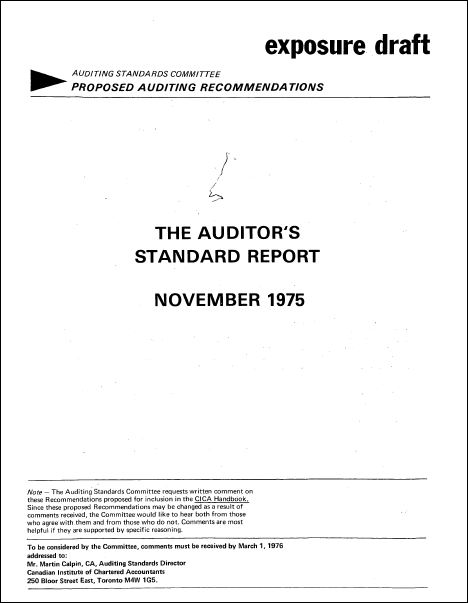
In November 1975, the Auditing Standards Committee of the Canadian Institute of Chartered Accountants issued an exposure draft dealing with The Auditor’s Standard Report. This Exposure Draft was the first stage of a complete updating and revision of the CICA Handbook Section 5500 - The Auditors’ Report.

According to the exposure draft, “The auditor's report is a comprehensive subject and the Committee believes that it would be useful and more efficient to divide present Section 5500 into several separate sections within the Handbook under such section headings as the following: Section 5400 The Auditor’s Standard Report; Section 5500 The Auditor’s Reporting Reservations; Section 5600 Special Reports; and Section 5700 Other Reporting Matters.”

The exposure draft stated that: “The auditor’s standard report is normally presented in two paragraphs. The first ("scope") paragraph identifies the financial statements reported on and contains a reference to the scope and nature of the auditor’s examination. The second ("opinion") paragraph expresses the auditor’s opinion resulting from that examination.” The major changes proposed in the exposure draft were (a) revision of the scope paragraph to state that the auditor’s examination was made in accordance with generally accepted auditing standards; and (b) removal of the two-part opinion concept.


Monday, August 6, 2012

Achieving International Harmonization of Accounting Standards (1975)


In July 1975, the Accounting Research Committee of the Canadian Institute of Chartered Accountants (CICA) issued an exposure draft on International Accounting Standards for inclusion in the CICA Handbook. The exposure draft notes that the CICA is a member of the International Accounting Standards Committee (IASC) whose objectives are “to formulate and publish in the public interest, basic standards to be observed in the presentation of audited accounts and financial statements,and to promote their worldwide acceptance and observance.”

The exposure draft sets out the procedures that the Accounting Research Committee will follow when an International Accounting Standard is issued. In addition, it notes that: “For companies that report in an international environment, it is desirable to disclose that accounting principles generally accepted in Canada have been followed in preparing the financial statements. It is also desirable to disclose conformity with or identify deviations from International Accounting Standards (but not necessarily the effect on the financial statements). Appropriate disclosure would be in the Summary of Accounting Policies.”


Friday, July 6, 2012

Generally Accepted Auditing Standards: Audit Evidence – 1977


In February 1975, the CICA’s Auditing Standards Committee (AuSC) proposed, subject to comments received following exposure, to publish the contents of an Exposure Draft as CICA Handbook: Section 5100 - Generally Accepted Auditing Standards. In July 1976, the AuSC issued a 32-page Exposure Draft on “Internal Control” (for inter-related Sections 5200 to 5230).

Then, in May 1977, the AuSC issued a 12-page Exposure Draft on “Audit Evidence” (for Sections 5300). This material was intended to provide guidance, in general terms, as to the attributes of audit evidence and the manner in which the auditor obtains and evaluates such evidence to adhere to field work standard (iii) within generally accepted auditing standards. Field work standard (iii) states: “"Sufficient appropriate audit evidence should be obtained, by such means as inspection, observation, enquiry, confirmation, computation and analysis, to afford a reasonable basis to support the content of the report.”

The Exposure Draft emphasized that “The auditor is concerned with audit evidence in all phases of his audit engagement, from the planning stage, through the study and evaluation of internal control including the performance of compliance auditing procedures, to the performance of substantive auditing procedures.” It addressed the following matters: Introduction and Definition; Knowledge of the Business; Necessity for Performing Substantive Auditing Procedures; Sufficiency and Appropriateness of Evidence; Methods of Obtaining Evidence; Timing of Auditing Procedures; Errors and Irregularities; and Evaluation of Audit Evidence. In this regard, “The auditor relies on his professional judgment [emphasis added] in deciding which procedures will give him sufficient appropriate audit evidence. He evaluates the audit evidence gathered to determine the content of his report.”

Thursday, June 21, 2012

Generally Accepted Auditing Standards: Internal Control – 1976


In February 1975, the CICA’s Auditing Standards Committee (AuSC) proposed, subject to comments received following exposure, to publish the contents of an Exposure Draft as CICA Handbook: Section 5100 - Generally Accepted Auditing Standards.

The following year, in July 1976, the AuSC issued a 32-page Exposure Draft on “Internal Control.” This material (for inter-related Sections 5200 to 5230) was intended to provide an explanation, in general terms, of what the auditor should do in order to comply with field work standard (ii) within Generally Accepted Auditing Standards (GAAS). Field work standard (ii) states: “There should be an appropriately organized study and evaluation of those internal controls on which the auditor subsequently relies in determining the nature, extent and timing of auditing procedures."


The Exposure Draft addressed the following matters: Management’s objectives; Basic components of internal control systems; Auditor's objective regarding internal control; Auditor's approach – overview; Auditor's study and evaluation; and, Relationship to substantive auditing procedures. A decision tree was provided in Appendix A on page 32 (refer to the graphic above). It is noteworthy that the Exposure Draft also mentioned that the AuSC was working on a project to provide a similar explanation with respect to field work standard (iii) - Audit Evidence.

Monday, February 27, 2012

The “Going Concern” Assumption: Accounting and Auditing Implications - 1991


The “Going Concern” Assumption: Accounting and Auditing Implications was published by the Canadian Institute of Chartered Accountants (CICA) in 1991. This 262-page research report was prepared by J.E. Boritz, PhD, FCA, supported by a seven-member advisory group. It assesses the financial reporting and auditing implications of the “going concern” assumption. Particular attention is given to the nature and extent of disclosures in the financial statements and/or auditor's report when there is insufficient support for the assumption due to significant risks or uncertainties facing either the industry or the enterprise.

The “going concern” assumption is important because it underlies generally accepted accounting principles. Financial statements are prepared on the basis that the entity is a “going concern”, meaning that it will continue in operation for the foreseeable future and will be able to realize assets and discharge liabilities in the normal course of operations.

According to the report, there were 8,664 business bankruptcies in Canada in 1989, accounting for about $2.2 billion in liabilities against assets of only $774 million, representing losses to creditors of more than $1.4 billion. In view of the economic significance of “going concern” disclosures, the lack of professional guidance, and the absence of standards in this area, the purpose of the report is to provide the basis for: 
  • an accounting standards project to address the financial reporting implications of the “going concern” assumption in the accounting section of the CICA Handbook;
  • an auditing standards project to modify CICA Handbook Section 5510, Reservations in the Auditor's Report, regarding auditor review of management's assertion as a “going concern”;
  • an audit techniques study to support the professional judgment process.
The report summarizes relevant pronouncements and current literature and surveys reporting practices in Canada and the United States. In addition, it fulfills its mandate by:
  • defining key terms including “financial distress”, “insolvency” and “bankruptcy”.
  • discussing whether any reference should be made to the “going concern” assumption in the notes to the financial statements.
  • assessing the financial reporting implications when there is insufficient support for the assumption.
  • identifying conditions which may bring into question the continuance of an entity as a “going concern”.
  • providing guidance on how doubts as to “going concern” status should be expressed.
  • evaluating alternative principles governing the presentation of financial information including historical cost, value realizable in orderly liquidation and discounted value.
  • determining the need for auditor review of the support for management's implicit or explicit “going concern” assumption.
  • assessing the audit implications and providing guidance for reporting when there is insufficient support or inadequate disclosure in the financial statements.
  • considering techniques to support the professional judgment process.
The report responds to recommendations in the 1990 publication Approaches to Dealing with Risk and Uncertainty and the 1988 Report of the Commission to Study the Public's Expectations of Audits, which noted the need to warn the public about the risk of business failure and the auditor's responsibility in that connection.

Wednesday, February 8, 2012

Generally Accepted Auditing Standards – 1975

Thirty-seven years ago, in February 1975, the CICA’s Auditing Standards Committee proposed, subject to comments received following exposure, to publish the contents of an Exposure Draft as CICA Handbook: Section 5100 - Generally Accepted Auditing Standards. This Exposure Draft was a re-exposure of material previously included in a November 1973 Exposure Draft. At that time the Committee used wording closely following and, in most places, identical to that used in the AICPA Statement on Auditing Standards No. 1, Codification of Auditing Standards and Procedures.

The Introduction said: "Although the Committee’s intention remains, as a general principle, to use words closely following AICPA Statements (or other professional pronouncements) in cases where this is appropriate, consideration of responses received to the 1973 Exposure Draft indicated that several significant changes were desirable in this particular case. The November 1973 Exposure Draft contained two other Sections of background material, which have been eliminated. "Responsibilities and Functions of the Independent Auditor" required extensive changes and will be dealt with at a later date. The discussion previously included under the heading "The General Standards" related to ethical matters [emphasis added], which are within the jurisdiction of the provincial Institutes and Order. Accordingly, it is the Committee’s intention not to deal further with this topic in the Auditing Recommendations Section of the CICA Handbook, other than including the substance of the three November 1973 general standards as one general standard in paragraph 5100.02 in the interest of completeness."

It is noteworthy that the Introduction also said that, oncurrent with the issuance of this Exposure Draft as an Auditing Recommendation, the Committee would intend to amend the Introduction to Auditing Recommendations by inserting the following as a new paragraph in the "Application" section:

"Among the Recommendations issued, GENERALLY ACCEPTED AUDITING STANDARDS, Section 5100, constitute the basic professional standards with which, in the Committee’s view, the auditor should comply when reporting upon financial statements. In adhering to such basic standards the auditor should have regard to the specific Auditing Recommendations in the Handbook while exercising his professional judgment [emphasis added] as to what procedures are required for such adherence. In addition, the Handbook provides Recommendations with respect to unaudited financial statements, to which Generally Accepted Auditing Standards do not apply."


Wednesday, January 18, 2012

Setting accounting and auditing standards in Canada - 1978


The article “Setting Accounting and Auditing Standards” was originally published in the September 1978 issue of CAmagazine. At that time, R.D. Thomas, FCA, was the CICA General Director of Research.

This article provides a detailed review of the existing standard-setting process. It notes that: “While the Research Department makes continual efforts to keep the 27,000 CICA members and over 13,000 other subscribers to the CICA Handbook informed on its projects in process, relatively few people appreciate the wide diversity of experience that those responsible bring to bear in the setting of Accounting and Auditing Recommendations, and the care they take in doing so."

"It’s important that those affected by these Recommendations know this background for at least two reasons:

(1) With the advent of the National Securities Administrators’ National Policy 27 and recent corporate legislation, Handbook Recommendations now have “authority” attached to them by federal and provincial government bodies, in addition to the support that has been given to them through the provincial institutes’ / order’s Rules of Professional Conduct.

(2) With the steady increase in the number and complexity of the subjects being dealt with by our research groups and with the resulting increasing demands on the time of volunteer members of these groups, a major study is now to be undertaken to see how our procedures can be improved. After reviewing the following highlight summary of the issues involved, any comments or suggestions you may have on present or prospective procedures and personnel will be very useful to the in-depth review which will be starting shortly.”

(For more information, refer to the CICA Special Committee on Standard-Setting (SCOSS), Report to the CICA Board of Governors on December 19, 1980.)

Wednesday, January 11, 2012

Report of the CICA Special Committee on Standard-Setting (SCOSS) - 1980


On December 19, 1980, the CICA Special Committee on Standard-Setting (SCOSS) presented its Report to the CICA Board of Governors. This comprehensive 158-page report states (pages 9-10) that: “If one is to consider the means by which accounting and auditing standards are to be set and maintained, one should first have a clear understanding of what is, or should be, the appropriate role, nature and scope of those standards.”

According to the SCOSS report: “A brief history of the standard-setting function in Canada and the way the nature and role of standards have evolved may help to set the stage. This history will essentially be that of accounting standards, since accounting standards as such have been in existence for much longer than auditing standards and they are, besides, much more in the public domain than auditing standards.

There have been accounting standards in Canada for a very long time. At no time in the past century would it have been possible for a preparer of financial statements to make up his own accounting practices without considering conventional usage, even though the accepted conventional practices may not have been published anywhere. Although our main concern today is for the development of published standards, it should not be forgotten that there are, even now, many accounting standards that are generally accepted and universally followed but have not yet been published. For example, there is no requirement in the CICA Handbook to depreciate fixed assets or to follow the matching principle generally.

The CICA published its first accounting standard in 1946. It was published in the form of a Bulletin, which continued to be the form of publication for more than twenty years. Twenty-six Bulletins were published between 1946 and 1967. Of these, six were published in the years 1965-67. In 1967, as a result of the report of a committee such as ours, the CICA Handbook came into existence and the Bulletins then in force were incorporated into it. The bulk of the material in the present Handbook has been added since 1968. The pace of standard-setting has clearly accelerated, and continues to do so.

It is difficult to generalize about the thought processes involved and the purposes behind projects carried out by standard-setters in the past. Nevertheless, it appears that the early Bulletins were essentially attempts to codify best existing practices rather than to change existing practice generally. In most cases the early Bulletins were non-controversial and the best practice was fairly clearly recognized. Their purpose was to discourage less desirable practices that were being followed in a minority of cases. Over time, however, the Bulletins, and later the Handbook, became progressively more innovative in the sense of changing practices generally rather than merely eliminating minority practices.

The trend away from codifying consensus to establishing new practice was due, in part, to the 1967 Report of the Study Group on Methods of Work and Organization (chaired by P.H. Lyons, FCA) which stated: “The Research Committee, to a much greater extent than it has in the past, should engage in initiating and overseeing basic research at the frontiers of our profession rather than gathering together to record the best current practice.”

Recent accounting standards, such as those on segmented reporting, accounting for leases and disclosure of transactions with related parties, have clearly changed the accounting and disclosure practices of the majority of Canadian enterprises rather than merely imposing on a stubborn minority accounting and disclosure practices already adopted by the majority. It is not always easy to categorize a particular standard as being essentially a codification of consensus on the one hand or a changing of the rules on the other – but, in general, the trend from the former approach to the latter seems indisputable. Moreover, the history of the process makes it apparent that this attitudinal change was primarily internally generated rather than forced on the profession from outside.

Undoubtedly, the most important development in the standard-setting arena since the Handbook came into existence is the conferring of quasi-legislative status on the Handbook. This process began with National Policy #27 adopted by the Canadian Securities Administrators in 1972. Since then, various federal and provincial statutes (and regulations thereunder) have come to require that financial statements prepared pursuant to those statutes must comply with the CICA Handbook.

The impact of this development on the perceived authority of the Handbook and the additional responsibilities it may, or may not, impose on standard-setters will be discussed later. However, while it is not possible to tell whether standards issued since the acquisition of this quasi-legislative status would have been different if such status had never been granted, it is possible that they might have been affected by the existence of this factor, and that future standards may be affected. The Handbook in its present form might be said to be largely a professionally- oriented set of standards with some of the latest (and future) additions perhaps being legislatively oriented. There could be conflicts in this potentially dual character of the Handbook.”

In addition to the above-noted discussion on the evolution of Canadian standards, the SCOSS report (pages 11-14) discusses the need for professional judgment in standard-setting, taking a principles-based approach, using principles rather than detailed rules, and clearly stating the role of professional judgment in the CICA Handbook. Although the report was issued more than 30 years ago, the observations and views of the Special Committee appear to be equally valid today. (For a review of the discussion on professional judgment, refer to the four-part series posted in the blog on Professional Judgment Matters.)


Wednesday, November 16, 2011

A Brief History of the Evolution of Accounting and Auditing Standards in Canada

Prior to 1951, the Canadian Institute of Chartered Accountants (CICA) was known as the Dominion Association of Chartered Accountants (DACA). It established an Accounting and Auditing Research Committee in 1946, which began issuing a series of bulletins setting out recommended standards of practice on accounting and auditing.


In 1968, it replaced the series of bulletins with a loose-leaf, subject-indexed Handbook that was periodically updated with inserts as the CICA’s committee issued new recommendations. Although the bulletins set out what the committee “considers to be the best accepted practice or its suggested treatment of new elements in accounting statements arising as a result of changes in social or economic conditions,” the recommendations contained in the Handbook were intended to possess greater force. Section 1500.06 in the Handbook, issued in November 1969, stated that any departures from the Handbook recommendations “should be explained in notes to the financial statements with an indication of the reason why the recommendation concerned was not followed.”

In 1975, the Canada Business Corporations Act added a degree of quasi-legislative authority to the Handbook, when Regulations 44 and 45 of the Act proclaimed:

44) The financial statements referred to in paragraph 149(1) of the Act shall, except as otherwise provided by this Part, be prepared in accordance with the standards, as they exist from time to time, of the CICA set out in the Handbook.

45) The auditor’s report referred to in Section 163 of the Act shall, except as otherwise provided by this Part, be prepared in accordance with the standards of the CICA set out in the Handbook.

In 1963, the CICA began publishing research studies on contemporary accounting and auditing topics. Since 1980, it has published a number of research studies on accounting and financial reporting, on auditing and assurance, and on environmental and performance reporting. Most are available as PDF downloads free-of-charge.

In 1991, the CICA replaced the Accounting Standards Committee and the Auditing Standards Committee with the Accounting Standards Board (AcSB) and the Auditing Standards Board. Later in that decade, the CICA Task Force on Standard Setting released its final report in May 1998, and among its recommendations was the establishment of an “independent standard setting organization for Canada.”

In addition, the CICA established the Accounting Standards Oversight Council (AcSOC) to support the setting of accounting standards domestically and to contribute to the development of internationally accepted standards. AcSOC’s mandate also includes providing opportunities for the public to comment on all aspects of accounting standard setting, and reporting to the public annually.

In 2005, a firm commitment was made to adopt International Financial Reporting Standards (IFRS), effective January 1, 2011. IFRS have now been incorporated into the CICA Handbook, along with International Auditing Standards (IAS).

Monday, September 19, 2011

Approaches to Dealing with Risk and Uncertainty - 1990 CICA Research Report

The 1990 CICA Research Report, Approaches to Dealing with Risk and Uncertainty, was prepared by J.E. Boritz, PhD, FCA. He was assisted by an 8-member Advisory Group. This Research Report (about 160 pages) was developed in response to a recommendation in the Report of the Commission to Study the Public's Expectations of Audits (published in June 1988), commonly referred to as the Macdonald Commission Report.

The recommendation in  the Macdonald Commission Report stated that "the CICA should initiate and complete as soon as possible a study of risks and uncertainties leading to conclusions as to how they may best be disclosed in financial statements or elsewhere (e.g., in Management's Discussion and Analysis in the annual report)." Accordingly, the primary purpose of the Research Report is to discuss and summarize some of the key issues, and to recommend what further action should be taken.

Wednesday, May 4, 2011

Canada's CAs symbolized by new logo


On June 1, 2007, Canada’s Chartered Accountants (CAs) got a new look as the profession unveiled a dynamic and modern redesigned logo. Updated for the first time since the early 1990s, the new CA logo reflects the leadership and value provided by the more than 72,000 CAs and 10,000 CA students in Canada and Bermuda. (See the CICA Annual Report 2006-2007 "Inspiring Confidence" - article on page 7.)

Thursday, December 31, 2009

Evolution of Accounting Standards in Canada

As the end of the first decade of the new millennium draws to a close, it is time to review the current status of standard-setting activities in Canada, ponder the future and reflect on the past. A special edition of FYI Accounting Standards, a periodic newsletter issued by staff of the Canadian Accounting Standards Board (AcSB), describes the implementation of the new strategic plan for publicly-accountable enterprises, private enterprises and not-for-profit organizations.


The FYI newsletter explains the changes in the accounting standards applicable to each type of reporting entity by listing those amendments to the CICA Handbook-Accounting that took effect in 2009 or that have been issued but are not yet effective. It also notes that the AcSB expects to include International Financial Reporting Standards (IFRS) in the Handbook early in 2010. In that regard, it lists amendments to IFRS that are effective for 2009, issued but not yet effective, and expected to be issued in 2010.


Migrating to IFRS will mean significant changes to both the accounting standards and the due process for developing future standards. Lest we forget, the standard-setting processes in Canada have evolved considerably over the years (as explained in CAmagazine articles spanning the period from 1976 to 1992). The evolution continues…